Dental Implants
Dental implants replace missing tooth roots with implants placed in the jaw, creating support for a crown, bridge, or other dental restoration. For the right patient, they can replace a single missing tooth or contribute to a larger tooth-replacement plan.
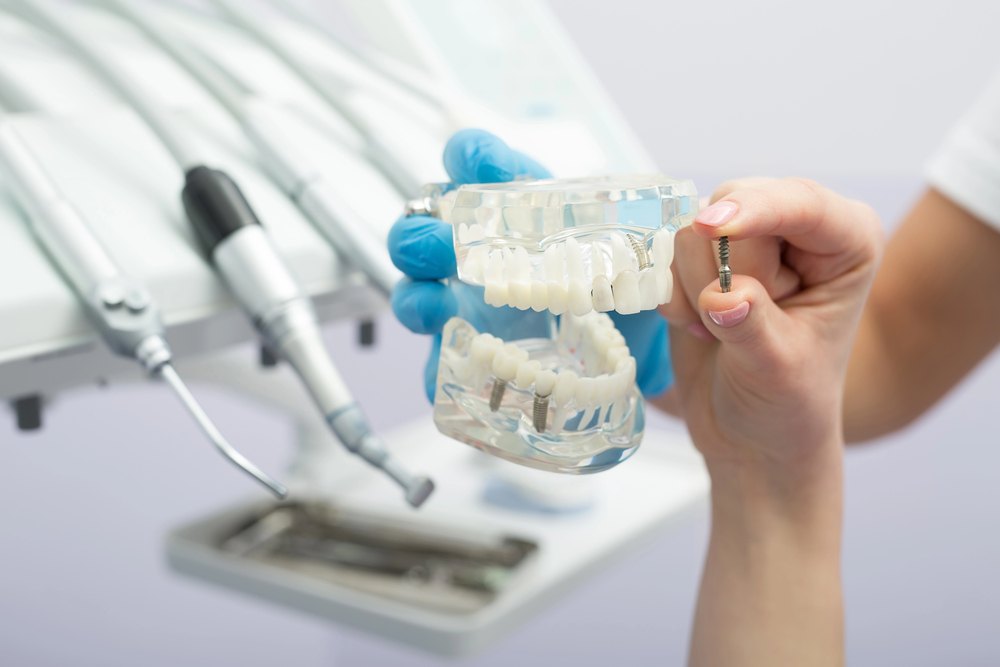
Implant treatment is staged and depends on gum health, available bone, medical history, bite, the missing-tooth location, and the restoration the implant ultimately needs to support.
What Does a Dental Implant Actually Replace?
The implant is the component placed in the jaw. After it is stable and ready for restoration, an abutment and dental restoration replace the visible portion of the missing tooth or teeth. The final restoration may be a crown, bridge, or another prosthetic design.
Who May Be a Candidate for Dental Implants?
- Healthy enough oral tissues to support implant treatment or a plan to treat active disease first.
- Adequate bone for the planned implant, or evaluation of whether grafting may be appropriate.
- A medical history that can be safely considered in surgical and restorative planning.
- A realistic plan for oral hygiene and ongoing professional maintenance.
- A bite and restorative plan that can place functional forces appropriately on the final restoration.
What If You Do Not Have Enough Bone?
Bone can shrink after tooth loss, and some sites begin with less volume than an implant plan requires. That does not automatically rule out treatment. Imaging and clinical evaluation help determine whether available bone is adequate or whether grafting or another approach should be considered.
The Dental Implant Process Is a Sequence
- Evaluation and planning: examine the mouth, review health history, and use appropriate imaging.
- Site preparation when needed: treat active disease, remove a non-restorable tooth, or complete grafting when appropriate.
- Implant placement: place the planned implant in the jaw under appropriate anesthesia and surgical protocols.
- Healing and integration: allow the implant and surrounding tissues to heal according to the clinical situation.
- Restoration: connect the components needed to support the final crown, bridge, or other prosthesis.
- Maintenance: monitor the implant, restoration, gums, bite, and home-care access over time.
Dental Implant vs. Dental Bridge
A traditional bridge uses neighboring teeth as supports. A dental implant creates support within the missing-tooth site itself. Neither is automatically right for every patient. A bridge may make sense when adjacent teeth already need crowns or surgery is not preferred. An implant may avoid preparing healthy neighboring teeth, but it requires surgery, adequate tissues, healing, and staged treatment.
How Long Does Implant Treatment Take?
There is no universal timeline. Treatment length depends on whether the tooth is already missing, whether extraction or grafting is needed, bone and gum condition, healing response, implant stability, and the final restoration.
What Changes the Cost of Implant Treatment?
The total plan can involve more than the implant itself. The number of teeth being replaced, diagnostic imaging, extraction, bone grafting, implant placement, abutments, temporary teeth when used, and the final restoration can all affect cost. A treatment-specific estimate is more useful than a single advertised implant price.
Moss Dental Studio publishes information about dental insurance and payment plans for treatment planning.
Dental Implants Still Need Ongoing Care
Implants cannot develop cavities, but tissues around them can become inflamed or diseased, and restorations can wear, loosen, or become damaged. Daily plaque control, professional maintenance, and monitoring of the bite and surrounding tissues remain important.
Review the practice’s existing dental implant information for additional service details.
Dental Implants
The Gold Standard for a Lifetime Smile
Why Choose Dental Implants?
An implant is more than just a cosmetic fix, it’s an investment in your long-term oral health. Unlike bridges, which rely on neighboring teeth for support, or dentures, which can slip, implants are anchored directly into the jaw.
Our Technology
The Implant Process
We know the idea of an implant can feel overwhelming. That’s why we’ve refined our process to be as gentle and transparent as possible.
Comprehensive Digital Mapping
We use 3D CBCT imaging to map your jaw structure with pinpoint accuracy before we ever begin.
Guided Placement
Our technology allows for minimally invasive placement, ensuring faster healing and more predictable results.
Bespoke Restoration
While your implant heals, we craft a custom-shaded crown in our studio that matches your existing teeth perfectly.
Dental Implants in Eden Prairie and Lakeville
Moss Dental Studio provides care from two Minnesota offices. Choose the location that works best for you when scheduling:
- Eden Prairie: 800 Prairie Center Dr, Suite 250, Eden Prairie, MN 55344 — call (952) 974-5116
- Lakeville: 18389 Orchard Trail, Lakeville, MN 55044 — call (612) 312-0087
For maps and office information, view the Moss Dental Studio locations or contact the dental team.
Questions Patients Ask
Are dental implants permanent?
Implants are designed as long-term tooth-replacement components, but no implant or restoration can be guaranteed for life. Health, hygiene, smoking, bite forces, maintenance, disease, and other factors affect outcomes.
Does implant surgery hurt?
Anesthesia is used during placement. Postoperative soreness and swelling vary by procedure and patient. Follow the case-specific aftercare instructions provided.
Can I get an implant immediately after an extraction?
Sometimes, but immediate placement depends on the site, infection status, bone, soft tissues, implant stability, and restorative plan. It is not appropriate for every extraction site.
What if I need a bone graft first?
Grafting may be recommended when the implant site does not have enough suitable bone for the planned implant. The type of graft and healing sequence depend on the defect and treatment plan.
How much do dental implants cost?
Cost depends on the number of implants, site preparation, grafting, surgery, components, and final restoration. A clinical evaluation is needed for a meaningful estimate.
Dental Implants FAQ
A Foundation Built for You
At Moss Dental Studio, we combine surgical precision with a boutique experience. You aren’t just another patient on a schedule—you’re a guest in our studio, and your comfort is our priority from the first scan to the final placement.
A dental implant is the only tooth-replacement option that actually saves your jawbone. When you lose a tooth, the bone underneath begins to shrink because it’s no longer being stimulated by a root. A bridge or denture only sits on top of the gums; an implant, however, is a titanium "root" that fuses to your bone (a process called osseointegration). This prevents bone loss and "facial collapse." Additionally, implants don't require us to grind down the healthy neighboring teeth—something that is necessary for a traditional bridge. They are independent, stable, and function exactly like a natural tooth.
This is the most common concern, and the answer is surprisingly no. Most of our patients tell us that the implant placement felt easier than a routine tooth extraction. We use advanced local anesthetics to ensure the site is completely numb. Because the jawbone itself has very few pain-sensing nerves, the discomfort is usually limited to the gum tissue, which heals very quickly. Most patients manage any post-op soreness with standard over-the-counter pain relief and are back to work the very next day.
Modern dental implants have a success rate of 95% to 98%. True "rejection" (like an organ transplant) is almost non-existent because titanium is "biocompatible"—your body doesn't recognize it as a foreign threat. When an implant fails, it’s usually due to poor bone density, smoking, or uncontrolled diabetes, which prevents the bone from gripping the implant. We mitigate these risks by using 3D CBCT imaging before we ever start. This allows us to see your bone structure in 3D and "virtually" place the implant on the computer first, ensuring we have the perfect foundation for a successful, lifelong result.
Missing a Tooth? Start With the Replacement Plan, Not the Procedure.
If you are comparing implants, bridges, or removable options, you do not need to choose before the dentist evaluates the space, bone, gums, neighboring teeth, and bite.
Schedule a tooth-replacement consultation so Moss Dental Studio can determine whether implant treatment fits your situation and explain the stages, alternatives, and expected responsibilities before you decide.
Eden Prairie: 800 Prairie Center Dr, Suite 250 — Call (952) 974-5116
Lakeville: 18389 Orchard Trail — Call (612) 312-0087